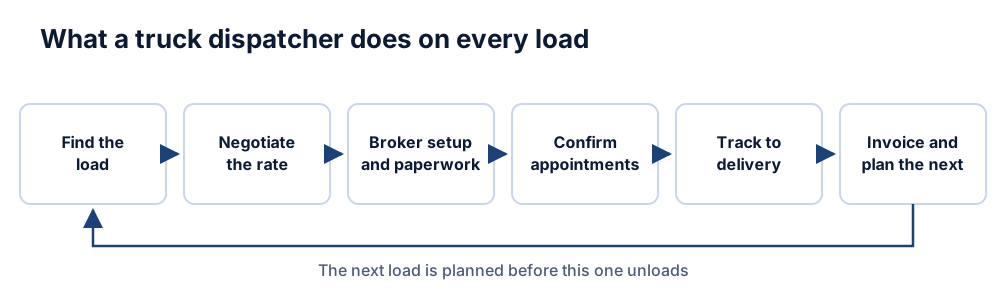
The job in sequence, not in bullet points
The work starts before a load exists. A dispatcher builds a lane plan around where your truck is, where you want to end up, your home-time window and your minimum acceptable rate per mile. Then they work the boards and their broker relationships against that plan rather than taking whatever is nearest. When a candidate load appears, they check the broker's credit and days-to-pay, verify the freight actually suits your equipment, and negotiate. Once you approve it, they handle the rate confirmation, the broker setup if it is a new customer, appointment confirmation, check calls, and the document chase at delivery.
Negotiation is most of the value
The posted rate on a load board is an opening position, not a price. A dispatcher who knows the lane knows what it paid last week and what the reload market looks like on the far end, which is the difference between arguing from data and haggling. The same conversation also decides accessorials — detention, layover, tarp pay, extra stops, TONU — which are frequently left unclaimed simply because nobody billed for them.
What a dispatcher is NOT
A dispatch service is not a freight broker and not a motor carrier. Brokers hold FMCSA broker authority, contract with shippers and are legally responsible for arranging transportation; they earn a margin on the load. A dispatcher works as the carrier's agent, under the carrier's own operating authority, and is paid by the carrier. This distinction matters legally and financially: your dispatcher should be on your side of the negotiation, not taking a cut from the other side of it.
Dispatcher versus load board
A load board is a listing service. It shows you what is posted; it does not negotiate, screen broker credit, handle your setups, chase your POD or plan your reload. Many carriers use both — the board is a source of loads, the dispatcher is the person working it all day while you are driving. The honest comparison is not cost versus free; it is what your time on the board is worth against what a dispatcher recovers in rate and unbilled accessorials.
What good looks like
You can judge a dispatcher on things that are actually measurable: your rate per mile against the market benchmark for that lane, your deadhead percentage, how long the truck sits between loads, and how much of your detention and accessorial revenue is actually collected. A dispatcher unwilling to show you those numbers in writing is asking to be judged on feel.
If you want this handled rather than researched: truck dispatch and broker negotiation.
Worth reading next: Six broker negotiation scripts that raise your rate without losing the load.
Unfamiliar with a term used above? The trucking glossary defines the words brokers, dispatchers and auditors actually use.
Want a straight answer about your own operation? Send your last ten loads. We will tell you what we would have done differently — including "nothing, you are doing fine", when that is the honest answer. Book a free audit, or read who runs the desk first.
Sources and further reading
This site publishes no performance statistics of its own, because none could be independently verified. Where a fact is checkable, here is where to check it — primary sources, not summaries of summaries.
- FMCSA — Broker and Freight Forwarder Registration — Defines broker authority, which a dispatch service does not hold.
- BLS — Cargo and Freight Agents, Occupational Outlook — US Bureau of Labor Statistics profile of the occupation, including duties and outlook.
Regulations, fees and processing times change. Verify current requirements directly with the issuing agency rather than relying on any third-party summary, including this one.