How the rolling tarp works
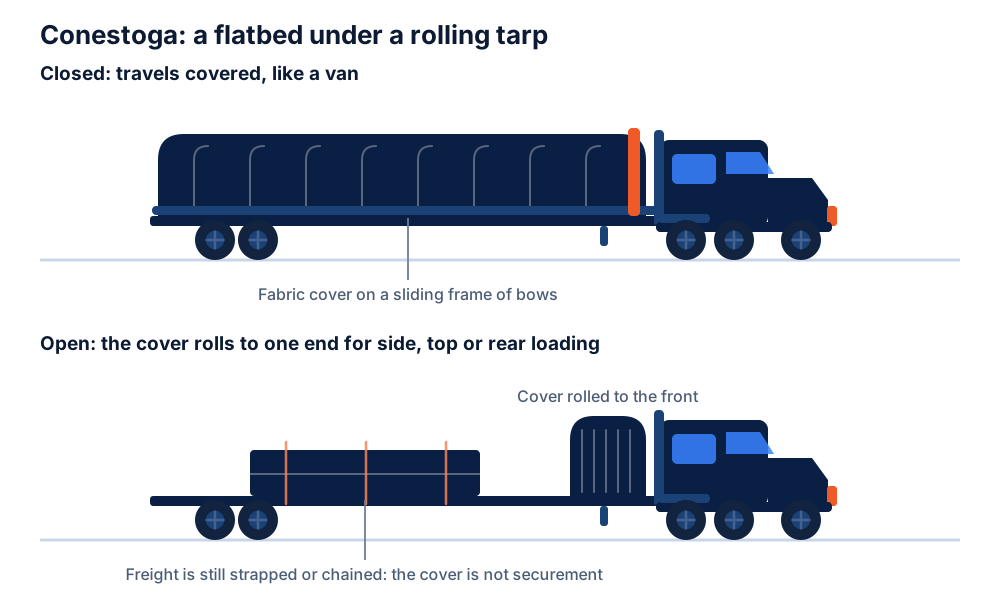
A series of aluminium or steel bows runs along the deck, carrying a heavy fabric cover. To load, the driver slides the whole assembly to the front or rear of the trailer, leaving the deck open to a forklift or crane from any side. Once the freight is secured, the cover rolls back over it and locks down. The name comes from the covered wagon it resembles. Conestogas are built on both flatbed and step deck frames, so flatbed Conestogas and drop deck Conestogas are quoted as different equipment.
What it hauls
Freight that has to be loaded like flatbed freight but cannot be exposed: machinery and electrical equipment, finished building products, aerospace and industrial parts, and anything a shipper does not want marked by straps and tarps. It also wins freight that is awkward to tarp at all — tall, irregular or easily damaged loads where a manual tarp job is slow and risky.
The cover is not securement
This is the mistake that costs Conestoga carriers. The cover keeps weather out; it does not hold the load. Cargo on a Conestoga must be secured to the same federal standard as cargo on an open flatbed — the cargo securement rules in 49 CFR Part 393, Subpart I — with straps, chains or other tie-downs rated for the load. An inspector can and will look under the cover.
The trade-offs against an open flatbed
The frame takes up room and weight. A Conestoga gives up some interior height and width compared with an open deck of the same size, and the tarp system adds weight, which comes off your legal payload under the 80,000 lb federal gross weight limit on the Interstate (23 CFR 658.17). Check the specific trailer’s interior clearance against the freight before you book, not at the dock. The gains are real: no tarping time, no tarp wear, no wet-freight claims, and faster loading.
Why it usually pays more
Fewer carriers run Conestogas, the trailers cost more to buy and maintain, and they solve a problem shippers will pay to have solved. That is why Conestoga rates generally run above open flatbed — see the market range on our Conestoga dispatch page, which is an estimate rather than a quote. The premium only holds if it is negotiated: a Conestoga booked at a flatbed rate is a flatbed with extra weight.
Conestoga vs open flatbed
| Conestoga | Open flatbed | |
|---|---|---|
| Weather protection | Built in — rolling cover | Manual tarps, where required |
| Loading | Side, top or rear once the cover is rolled back | Side, top or rear |
| Tarping time | None | Can be hours on a full load |
| Interior clearance | Reduced by the frame | Open — limited only by legal height |
| Tare weight | Heavier — less legal payload | Lighter |
| Oversize freight | Generally not | Yes, with permits |
| Typical pay | Above flatbed, when negotiated as Conestoga | Flatbed rates |
Both need cargo secured to the federal standard. The Conestoga cover keeps the weather out; it does not hold the load.
If you want this handled rather than researched: broker negotiation and truck dispatch.
Worth reading next: Six broker negotiation scripts that raise your rate without losing the load.
Unfamiliar with a term used above? The trucking glossary defines the words brokers, dispatchers and auditors actually use.
Want a straight answer about your own operation? Send your last ten loads. We will tell you what we would have done differently — including "nothing, you are doing fine", when that is the honest answer. Book a free audit, or read who runs the desk first.
Sources and further reading
This site publishes no performance statistics of its own, because none could be independently verified. Where a fact is checkable, here is where to check it — primary sources, not summaries of summaries.
- eCFR — 49 CFR Part 393, Subpart I: Protection against shifting and falling cargo — The federal cargo securement standard — it applies under a Conestoga cover exactly as on an open deck.
- eCFR — 23 CFR Part 658: Truck size and weight — The 80,000 lb Interstate gross weight limit and the 102-inch width standard.
Regulations, fees and processing times change. Verify current requirements directly with the issuing agency rather than relying on any third-party summary, including this one.