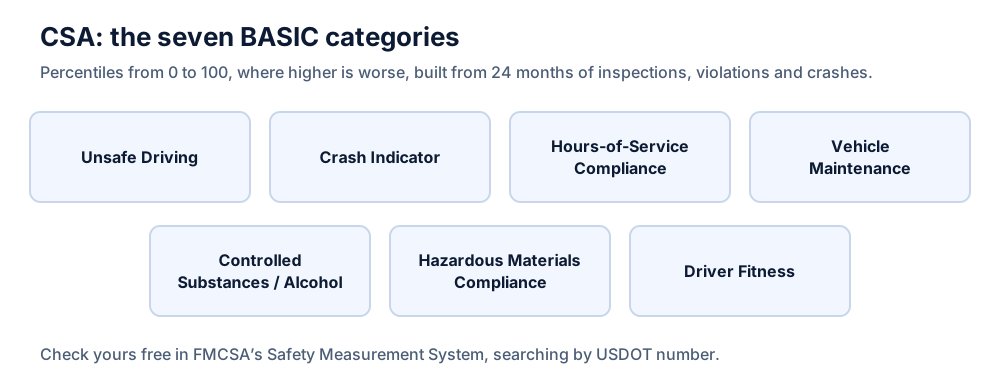
The seven BASICs, and what lands in each
CSA does not produce one number. It produces a percentile per category, and FMCSA calls those categories BASICs — Behavior Analysis and Safety Improvement Categories. They are Unsafe Driving, Crash Indicator, Hours-of-Service Compliance, Vehicle Maintenance, Controlled Substances and Alcohol, Hazardous Materials Compliance, and Driver Fitness. A logbook violation hits Hours-of-Service. A brake or light violation hits Vehicle Maintenance. A missing medical certificate hits Driver Fitness. Which BASIC a violation lands in matters more than most carriers realise, because each one is scored and compared separately.
Why it is a percentile, not a grade
This is the single most misunderstood thing about CSA. Your score is not a mark out of a hundred — it is your rank against a peer group of carriers with a comparable number of inspections. A percentile of 75 does not mean you passed 75% of something. It means roughly 75% of comparable carriers look safer than you in that category. Because it is relative, your score can move even in a month where you did nothing differently, simply because the carriers around you did.
Recency and severity are weighted
Not every violation counts the same. FMCSA weights violations by severity, and by how recent they are, over a rolling 24-month window. A serious violation from last month carries far more weight than a minor one from eighteen months ago. Two practical consequences: a bad quarter does fade, and a clean stretch genuinely repairs the number — but slowly, because time has to pass for the old events to decay out.
What a bad score actually costs you
Three things, in rising order of pain. First, FMCSA prioritises carriers with high percentiles for interventions — warning letters, investigations, on-site audits. Second, many brokers and shippers screen CSA before they set you up, so a high Unsafe Driving or Vehicle Maintenance percentile can quietly cost you freight you never knew you were being considered for. Third, insurers look at it at renewal. The compliance cost is rarely the expensive part; the lost freight and the premium are.
How to actually improve it
Clean inspections are the only real lever, and the way to get them is a pre-trip that catches what an inspector would catch — lights, brakes, tyres, securement. After that: contest inaccurate violations through FMCSA’s DataQs process rather than accepting them, keep driver qualification files current so Driver Fitness stays clean, and fix hours-of-service discipline, because HOS violations are among the easiest to accumulate and the easiest to prevent. There is no shortcut and no service that can delete a legitimate violation.
What MSM Transit does with this
We monitor the BASICs that trigger interventions for the carriers we run compliance for, keep driver qualification files current, and flag a percentile trending the wrong way before it becomes an audit letter. What we do not do is promise to lower a score — nobody can, and anyone who says otherwise is selling something. The work is keeping the inputs clean.
If you want this handled rather than researched: safety & compliance and driver management.
Worth reading next: The FMCSA compliance checklist every carrier should run quarterly.
Unfamiliar with a term used above? The trucking glossary defines the words brokers, dispatchers and auditors actually use.
Want a straight answer about your own operation? Send your last ten loads. We will tell you what we would have done differently — including "nothing, you are doing fine", when that is the honest answer. Book a free audit, or read who runs the desk first.
Sources and further reading
This site publishes no performance statistics of its own, because none could be independently verified. Where a fact is checkable, here is where to check it — primary sources, not summaries of summaries.
- FMCSA — Safety Measurement System (SMS) — The official system. Look your own carrier up here.
- FMCSA — Compliance, Safety, Accountability — What the programme is and how FMCSA uses it.
- FMCSA — SMS Methodology — How the percentiles are actually calculated, in FMCSA's own words.
Regulations, fees and processing times change. Verify current requirements directly with the issuing agency rather than relying on any third-party summary, including this one.