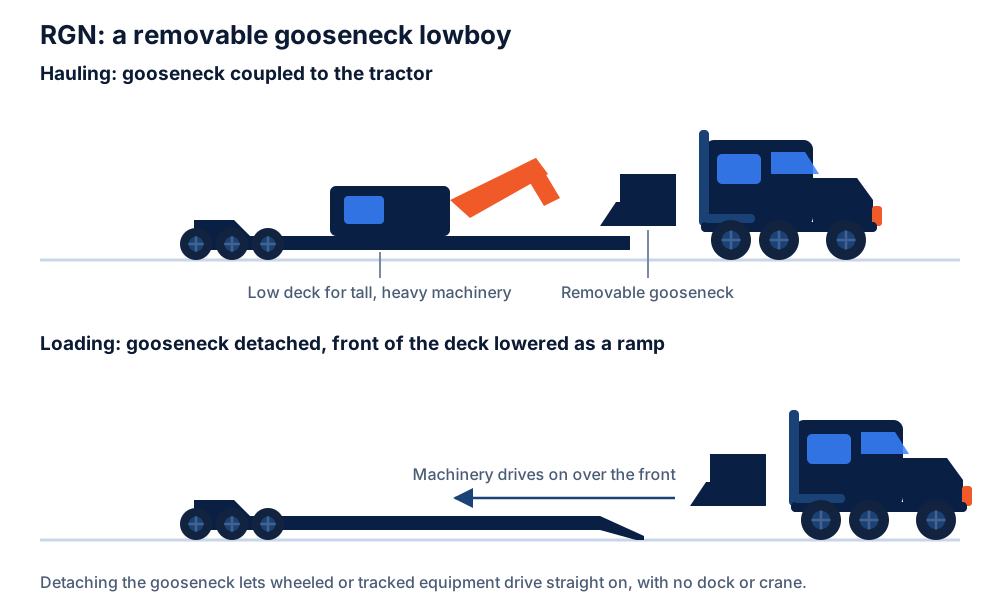
How the gooseneck actually works
The gooseneck is the section that connects the trailer to the tractor. On an RGN it detaches hydraulically and lowers the front of the deck to the ground, turning the deck itself into a ramp. An excavator, dozer or tractor is then driven straight on rather than craned or winched up. Reattach the gooseneck, raise the deck, and you are loaded. That one capability is the whole reason the equipment exists — it makes self-propelled machinery loadable anywhere there is firm ground, with no dock and no crane.
RGN vs lowboy vs step deck
These get used loosely, so worth being precise. A step deck (or drop deck) has two deck heights and carries freight too tall for a dry van but still under permit height — no detaching front, load it from a dock or by forklift. A lowboy has a very low main deck for tall heavy freight; the term is often used interchangeably with RGN, but strictly a lowboy describes the low deck profile while RGN describes the detachable front. Most modern lowboys in heavy haul ARE removable gooseneck, which is why the words blur. If someone says lowboy and you need to drive equipment on, confirm it is an RGN.
Deck height is the point
A low deck buys you vertical clearance. Typical legal height limits mean a tall machine on a standard flatbed is over height and needs a permit; the same machine on a low RGN deck may sit under the limit, or need a far cheaper permit. That is why RGN rates look high in isolation and are often the cheaper answer once permits, escorts and routing are priced in. The trailer is not expensive — the alternative is.
Axles, weight and the bridge formula
Heavy freight is not just about total weight but how it is distributed. Federal bridge formula rules relate allowable weight to axle spacing, which is why RGNs come in multi-axle configurations and why flip axles and jeeps exist. A load that is legal on one configuration is over on another at the same gross weight. Getting this wrong is not a fine you absorb — it can mean being shut down at a scale with a loaded trailer and nowhere to go.
What makes RGN loads go wrong
Almost always permits and routing discovered after committing. Multi-state permits take time and each state has its own rules. Route surveys, bridge restrictions, escort or pilot car requirements and curfew hours all cost money and all need pricing before you accept, not after. The second most common failure is ground conditions at pickup: an RGN needs firm level ground to load, and a muddy site turns a straightforward load into a recovery.
Who runs RGN freight
Owner-operators and carriers in heavy haul — construction equipment, agricultural machinery, drilling and energy equipment, transformers, industrial plant. It pays the best rates per mile in trucking and punishes planning mistakes hardest, which is a fair summary of the whole segment.
RGN vs lowboy vs step deck vs flatbed
| Deck height | Front detaches? | Loading method | Typical freight | |
|---|---|---|---|---|
| RGN / removable gooseneck | Very low | Yes — becomes a ramp | Drive machinery straight on | Excavators, dozers, self-propelled equipment |
| Lowboy | Very low | Usually — most are RGN | Ramp, crane or drive-on | Tall heavy machinery |
| Step deck / drop deck | Two heights, lower rear | No | Dock, ramps or forklift | Freight too tall for a van, under permit height |
| Flatbed | Single, highest | No | Forklift or crane, side load | Steel, lumber, building materials |
Height and weight limits vary by state. Confirm loaded dimensions against each state on the route before accepting.
If you want this handled rather than researched: safety & compliance and route planning.
Worth reading next: The FMCSA compliance checklist every carrier should run quarterly.
Unfamiliar with a term used above? The trucking glossary defines the words brokers, dispatchers and auditors actually use.
Want a straight answer about your own operation? Send your last ten loads. We will tell you what we would have done differently — including "nothing, you are doing fine", when that is the honest answer. Book a free audit, or read who runs the desk first.
Sources and further reading
This site publishes no performance statistics of its own, because none could be independently verified. Where a fact is checkable, here is where to check it — primary sources, not summaries of summaries.
- FMCSA — Oversize/Overweight Permits and Routing — Federal starting point; permits themselves are issued state by state.
- US DOT — Federal Bridge Formula — How axle spacing and weight interact, which is what decides an RGN configuration.
Regulations, fees and processing times change. Verify current requirements directly with the issuing agency rather than relying on any third-party summary, including this one.