How detention is measured
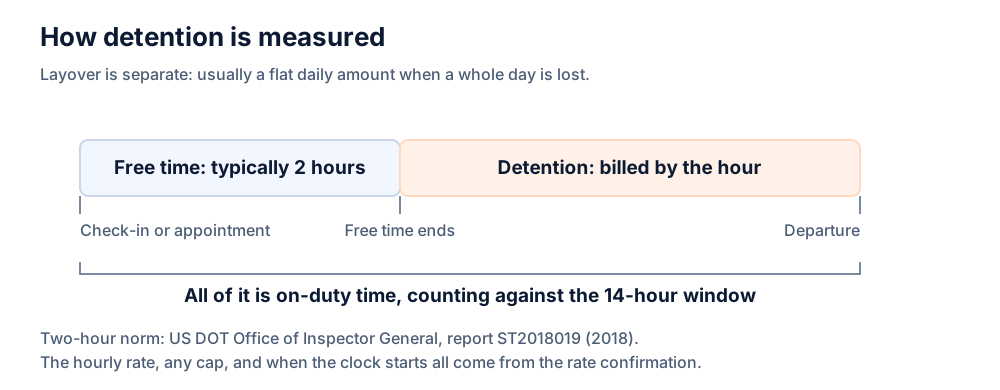
The clock starts at the appointment time or at your check-in, whichever the rate confirmation says, and detention begins when free time runs out. The US DOT Office of Inspector General found that contracts typically allow two hours before detention fees apply, and that 11 of the 12 industry stakeholders it interviewed described an informal consensus that two hours is a reasonable time to load or unload (Report ST2018019, January 2018). The hourly rate, any cap, and whether the clock runs from arrival or from the appointment all come from the rate confirmation.
Why it costs more than the hourly rate suggests
Time waiting at a dock is generally on-duty time under the hours-of-service rules unless the driver is relieved of all duty, so it runs down the same 14-hour window you need for driving (49 CFR Part 395). A three-hour wait can cost you the next load, not just three hours. The same Inspector General report estimated that detention is associated with $1.1 billion to $1.3 billion a year in lost earnings for for-hire truckload drivers, and that a 15-minute increase in average time at a facility raises the expected crash rate by 6.2 percent.
How layover works
Layover applies when a load is not ready until the next day, when a delivery is pushed back overnight, or when the truck is otherwise held long enough that the day is lost. It is usually a flat amount per day rather than an hourly rate. Like detention, it exists only if it is in the agreement — the rate confirmation or the broker’s carrier terms — so check before you accept.
Getting detention paid
Know the terms before you roll: free time, hourly rate, any cap, and the notice the broker requires. Most brokers want to hear from you before free time runs out, not after. Record your arrival and departure — in and out times written and signed on the bill of lading where you can, plus your ELD record and timestamped photos. Notify the broker in writing as you approach the end of free time, then invoice detention with the evidence attached as soon as the load delivers.
When the shipper paid and you did not
Detention can be billed to the shipper by a broker and never reach the carrier. Federal rules give each party to a brokered transaction the right to review the broker’s record of that transaction (49 CFR 371.3), which includes the compensation the broker received and who paid it. Most disputes never get that far — a clean paper trail settles them — but the right exists. The whole paper trail, charge by charge, is in our guide to accessorial pay.
If you want this handled rather than researched: billing & invoicing and broker negotiation.
Worth reading next: Detention, layover and TONU: a carrier’s guide to getting accessorials paid.
Unfamiliar with a term used above? The trucking glossary defines the words brokers, dispatchers and auditors actually use.
Want a straight answer about your own operation? Send your last ten loads. We will tell you what we would have done differently — including "nothing, you are doing fine", when that is the honest answer. Book a free audit, or read who runs the desk first.
Sources and further reading
This site publishes no performance statistics of its own, because none could be independently verified. Where a fact is checkable, here is where to check it — primary sources, not summaries of summaries.
- US DOT Office of Inspector General — Estimates Show Commercial Driver Detention Increases Crash Risks and Costs (Report ST2018019, January 2018) — The source for the two-hour free-time norm, the lost-earnings estimate and the crash-rate finding.
- eCFR — 49 CFR Part 395: Hours of service of drivers — How time waiting at a facility counts as on-duty time.
- eCFR — 49 CFR 371.3: Records to be kept by brokers — Each party to a brokered transaction has the right to review the broker’s record of it.
Regulations, fees and processing times change. Verify current requirements directly with the issuing agency rather than relying on any third-party summary, including this one.