When a TONU applies
The usual cases: the load is cancelled after you have been dispatched and are on your way; you arrive and the freight is not there, or not ready, and the load is cancelled; or the load is given to another truck after you were confirmed. It usually does not apply when the carrier cancels, arrives too late for the appointment, or turns up with equipment that does not match the order.
How much it should be
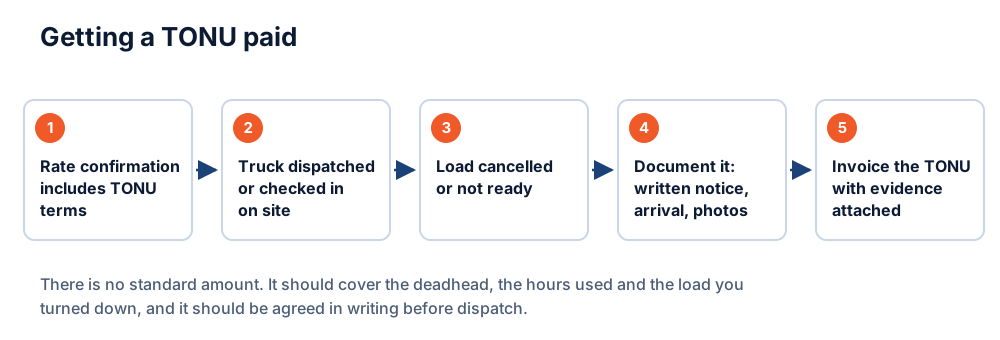
There is no federal rule and no industry-wide figure. What a TONU should cover is what the cancellation cost you: the deadhead miles you drove, the hours of service you used getting there, and the load you turned down to take this one. That is the number to have in mind when you negotiate it — and the time to negotiate it is before dispatch, in writing on the rate confirmation, not after the load falls through.
Make it collectable before you roll
Read the rate confirmation for a TONU clause before you accept. If there is none, ask for one in writing. Many brokers attach conditions — a cutoff before the pickup appointment after which a TONU applies, or a requirement that you are checked in on site. Know those conditions, because they decide whether you get paid.
When it happens, document it
Tell the broker in writing the moment you learn the load is cancelled or not ready. Record your arrival time and location — your ELD record is evidence, and so is a timestamped photo at the gate. Get the cancellation itself in writing, by email or message, with the reason. Then invoice the TONU promptly with that evidence attached. A TONU invoiced a week later with no paper trail is the one that gets disputed.
Sometimes a reload beats a TONU
A broker who cancels on you may have another load nearby. If it is a good load, taking it can be worth more than the TONU — but agree in writing whether you are getting the TONU as well, rather than assuming. For detention, layover and the other charges a load can earn, see our guide to accessorial pay.
If you want this handled rather than researched: broker negotiation and billing & invoicing.
Worth reading next: Detention, layover and TONU: a carrier’s guide to getting accessorials paid, and Six broker negotiation scripts that raise your rate without losing the load.
Unfamiliar with a term used above? The trucking glossary defines the words brokers, dispatchers and auditors actually use.
Want a straight answer about your own operation? Send your last ten loads. We will tell you what we would have done differently — including "nothing, you are doing fine", when that is the honest answer. Book a free audit, or read who runs the desk first.
Sources and further reading
This site publishes no performance statistics of its own, because none could be independently verified. Where a fact is checkable, here is where to check it — primary sources, not summaries of summaries.
- eCFR — 49 CFR Part 395: Hours of service of drivers — How on-duty time is counted — the hours a cancelled load can cost you.
Regulations, fees and processing times change. Verify current requirements directly with the issuing agency rather than relying on any third-party summary, including this one.