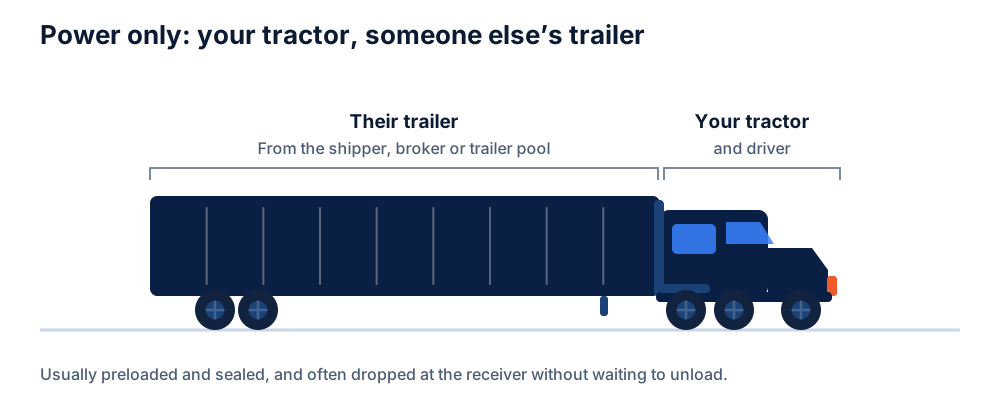
Three kinds of power only work
Most power only freight comes in one of three shapes. Pool freight: a broker or logistics company keeps trailers staged at yards and pays tractors to move them, loaded or empty. Shipper drop programs: a manufacturer or retailer keeps trailers at its own docks, loads them on its own schedule, and wants carriers who will reliably take them away on repeat lanes. Relays: a load is split into legs and each tractor runs one, swapping trailers at a handoff point. Each shape pays and behaves differently, and a carrier who treats them as one thing usually ends up running the worst of each.
How trailer pools decide your week
A pool is an inventory problem for its owner: trailers have to be where freight is about to load. So the loaded moves pay, and the repositioning moves — empties going back to where they are needed — pay less but have to happen. Carriers who ask only for loaded moves often wait. Carriers who take a sensible share of repositioning tend to get first call on the loaded freight. Ask any program how it releases trailers: on a board everyone sees, on a schedule to committed carriers, or by relationship. The answer tells you how predictable your week will be.
Read the interchange agreement before you sign it
The trailer interchange agreement is the contract that hands you someone else’s trailer. It sets when your responsibility starts and ends — usually at the hook and the drop — what you are liable for if the trailer is damaged or stolen in your care, how much insurance you must carry, how quickly you must return the trailer, and whether you may use it for anything else. Read the liability and indemnity clauses closely: some agreements leave the carrier responsible for damage it did not cause unless that damage was documented at the hook. Know your trailer interchange insurance limit, and compare it with what the agreement requires and what the trailers are worth.
Inspect and document at every hook
This is where power only carriers lose money they never get back. Before you hook, walk the trailer: tires, lights, brakes, air lines, doors, floor and roof where you can see them. Federal rules require the driver to be satisfied the vehicle is in safe operating condition before driving it (49 CFR 396.13), and every trailer must carry documentation of a periodic inspection within the preceding 12 months (49 CFR 396.17). If the decal or report is missing or out of date, do not pull the trailer until the owner sorts it out. Photograph all four sides and any existing damage, with timestamps, and record the seal number on the bill of lading. Do the same at the drop. Five minutes of photos is the difference between a damage claim you win and one you pay.
The arithmetic: per working day, not per mile
Power only usually pays less per loaded mile than pulling your own trailer, and that comparison misleads in both directions. What you gain is dock time — preloaded trailers and drop and hook mean hours you are not sitting — and a trailer’s costs you never carry. What you lose is choice: your next load generally comes from the same program, so the distance from your drop to the next available trailer decides the week. Work it out as revenue per working day, with bobtail and empty-move miles counted, and compare it with your best own-trailer week. Our deadhead math applies here with even more force.
Who power only suits — and who it does not
It suits fleets with more tractors than trailers, carriers adding trucks without adding trailer payments, and owner operators who want dense, repeatable regional work with little dock time. It does not suit carriers whose lanes run through thin markets, because the bobtail to the nearest pool eats the advantage, or carriers who want to pick spot freight from any broker. Many fleets run a mix: power only on the dense lanes, their own trailers where freight is spread out. The short version is in what power only loads are and how carriers get them.
Questions to ask a program before you commit
How are trailers released, and to whom first? What share of the work is empty repositioning, and how is it paid? What does the interchange agreement make me liable for, and what insurance limit does it require? How is detention handled at shipper drop lots when a trailer is not ready? How fast do you pay, and is there a quick-pay option? Who answers at 2 a.m. when the trailer at the yard is not the one on the paperwork? A program that answers all of these clearly is usually a program that runs well.
This is the thinking behind truck dispatch, route planning and factoring assistance — the same analysis, run for you every week instead of read about once.
It applies hardest to power only freight and dry van freight, where the margin is thin enough that the arithmetic decides the week.
Want this applied to your trucks instead of read about? Our dispatchers run this analysis on every account, every week. Book a free audit and we will run it on your last ten loads.