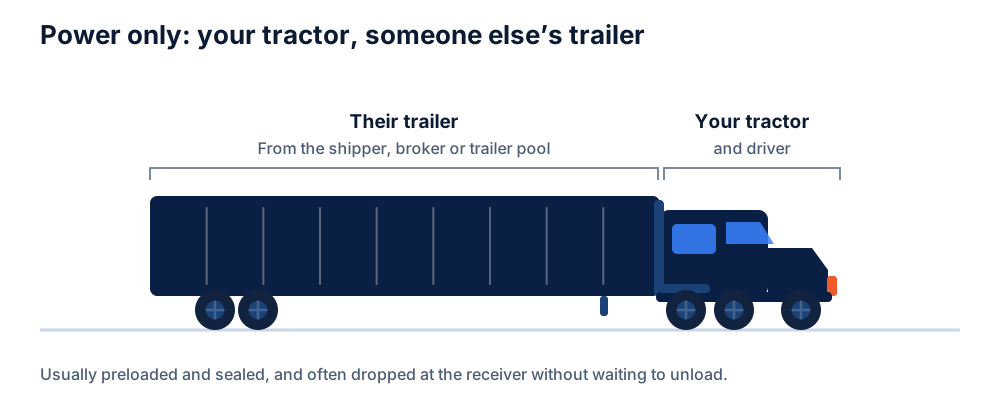
How a power only load actually runs
You arrive at a yard or a shipper’s drop lot, hook a trailer that is usually already loaded and sealed, and deliver it — often dropping it at the receiver and leaving without waiting to unload. The trailer belongs to someone else: a shipper with its own trailers, a broker or logistics company that runs a trailer pool, or a leasing company. Some power only work is moving empty trailers to where they are needed. That pays less, but it keeps a pool balanced and can be the reload that gets you home.
Where carriers find power only freight
Three places. Broker and logistics-company trailer programs, which keep trailers staged at yards and need tractors to move them. Shipper drop-trailer programs, where a manufacturer or retailer keeps trailers at its docks and wants dependable carriers on repeat lanes. And the major load boards, which list power only as its own equipment type. Large marketplaces such as Amazon Relay post power only work too. Every program sets its own entry requirements — authority age, safety record, insurance — so check them directly before you build a plan around one.
What it asks of you that a normal load does not
Insurance first. Most programs require trailer interchange coverage, which pays for physical damage to a trailer you do not own while it is in your care under a written interchange agreement. You still need your own operating authority and liability cover: the federal minimum for for-hire general freight is $750,000 (49 CFR 387.9), and brokers commonly require $1 million. Then inspection. Before driving, federal rules require you to be satisfied the vehicle — trailer included — is in safe operating condition (49 CFR 396.13), and every trailer must carry documentation of a periodic inspection within the preceding 12 months (49 CFR 396.17). Check the decal or paperwork before you hook.
The trade-off: capital and speed against control
The case for power only is what you do not have to buy: no trailer payment, no trailer tires, no trailer registration, and fewer hours at a dock because preloaded trailers turn fast. The cost is control. You can only pull the trailers a program gives you, so your next load usually has to come from the same program — or you bobtail to it. Rates per mile typically sit below what you would earn pulling your own trailer, because you are supplying less. Whether power only pays is a deadhead question more than a rate question: how far is the next hook from where you drop?
When power only is the right call
It suits a carrier adding trucks without adding trailers, a fleet with more tractors than trailers, or an owner operator who wants dense regional lanes with little dock time. It is a poor fit where lanes are thin, because empty miles to reach a trailer pool eat the advantage. That map — where the pools are, how often they release trailers, and what the bobtail miles cost against the rate — is the first thing to work out, and it is where our power only dispatch starts. The full picture of pools, drop programs and interchange agreements is in our power only guide.
Power only vs pulling your own trailer
| Power only | Your own trailer | |
|---|---|---|
| Trailer cost | None — supplied by the program | Purchase or lease, tires, registration, repairs |
| Dock time | Low — mostly preloaded drop and hook | Varies — often live load and unload |
| Rate per mile | Usually lower | Usually higher |
| Where reloads come from | Mostly the same program | Any broker, any board |
| Extra insurance | Trailer interchange, usually required | Physical damage cover on your own trailer |
| Biggest risk | Deadhead to the next trailer | Dock delays and an idle trailer |
Compare revenue per working day, not per mile — the dock time saved is where power only earns its keep.
If you want this handled rather than researched: truck dispatch and route planning.
Worth reading next: Power only: trailer pools, drop programs and interchange agreements, and Deadhead math: why a $3.10 load can pay less than a $2.60 load.
Unfamiliar with a term used above? The trucking glossary defines the words brokers, dispatchers and auditors actually use.
Want a straight answer about your own operation? Send your last ten loads. We will tell you what we would have done differently — including "nothing, you are doing fine", when that is the honest answer. Book a free audit, or read who runs the desk first.
Sources and further reading
This site publishes no performance statistics of its own, because none could be independently verified. Where a fact is checkable, here is where to check it — primary sources, not summaries of summaries.
- eCFR — 49 CFR 387.9: Minimum levels of financial responsibility — The $750,000 federal minimum for for-hire carriers of general freight.
- eCFR — 49 CFR 396.13: Driver inspection — The driver must be satisfied the vehicle is in safe operating condition before driving it.
- eCFR — 49 CFR 396.17: Periodic inspection — Every commercial vehicle, trailers included, needs an inspection within the preceding 12 months, documented on the vehicle.
Regulations, fees and processing times change. Verify current requirements directly with the issuing agency rather than relying on any third-party summary, including this one.