Why step decks command more
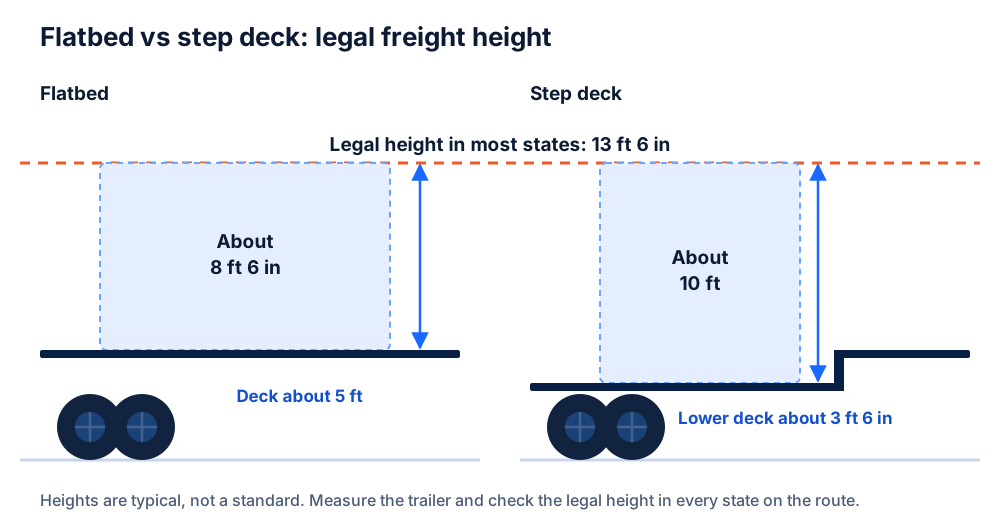
A step deck’s lower deck lets freight around 10 ft tall run without an oversize permit, against roughly 8 ft 6 in on a standard flatbed in states with a 13 ft 6 in limit. That puts machinery, vehicles and tall crated freight out of a flatbed’s reach unless it buys permits. Fewer trailers can take that freight, so it pays a premium. The market ranges on our equipment pages reflect that, with step deck above flatbed — both are estimates to orient you, not quotes. The height arithmetic is laid out in what a step deck trailer is.
Why flatbeds stay busier
More freight fits a flatbed: steel, lumber, pipe, building materials and long loads that need the full deck at one height. More shippers default to flatbed, and more brokers post it. That volume is worth money too — a flatbed with a reload waiting can out-earn a step deck that pays more per load but sits a day for the next one.
Length and loading
A flatbed gives you the whole deck at one height, which suits long freight. A step deck loses the first 10 or 11 ft to the upper deck, so long freight that cannot sit across the step will not fit, and loads that bridge both decks need careful securement. Step decks with ramps can take drive-on equipment that a flatbed cannot load without a dock or crane.
Run it per working day
The real question is not which pays more per mile but which earns more per week on your lanes. Count reloads and deadhead: a step deck’s higher rate disappears fast if every load ends in a market with no tall freight going back. Look at what moves out of the markets you deliver into most, and decide on that — the same logic as our deadhead math.
Running both
Many step deck carriers also book flatbed freight that fits the lower deck, which keeps the truck moving between tall loads. That flexibility is one of the strongest arguments for a step deck — as long as the flatbed loads are priced as flatbed freight and the step deck premium is negotiated on the loads that actually need it.
Flatbed vs step deck at a glance
| Flatbed | Step deck | |
|---|---|---|
| Deck height (typical) | About 5 ft | About 3 ft 6 in on the lower deck |
| Legal freight height at a 13 ft 6 in limit | About 8 ft 6 in | About 10 ft on the lower deck |
| Usable length | Full deck at one height | Lower deck only, for tall freight |
| Drive-on equipment | Needs a dock or crane | Possible with ramps |
| Freight volume | Higher | Lower, more specialised |
| Pay per load | Lower | Usually higher |
Heights are typical, not a standard — measure the trailer, and check the legal height in every state on the route.
If you want this handled rather than researched: broker negotiation and route planning.
Worth reading next: Deadhead math: why a $3.10 load can pay less than a $2.60 load, and Six broker negotiation scripts that raise your rate without losing the load.
Unfamiliar with a term used above? The trucking glossary defines the words brokers, dispatchers and auditors actually use.
Want a straight answer about your own operation? Send your last ten loads. We will tell you what we would have done differently — including "nothing, you are doing fine", when that is the honest answer. Book a free audit, or read who runs the desk first.
Sources and further reading
This site publishes no performance statistics of its own, because none could be independently verified. Where a fact is checkable, here is where to check it — primary sources, not summaries of summaries.
- eCFR — 23 CFR Part 658: Truck size and weight — Federal width and weight limits. Height limits are set by each state.
- eCFR — 49 CFR Part 393, Subpart I: Cargo securement — The securement standard for loads on either deck, including loads that bridge the step.
Regulations, fees and processing times change. Verify current requirements directly with the issuing agency rather than relying on any third-party summary, including this one.