Why the step matters
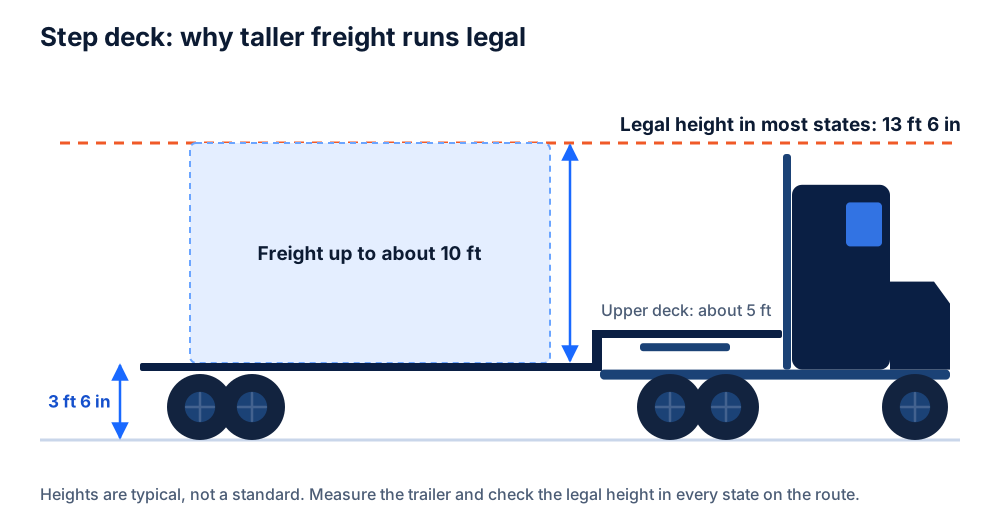
Legal height is measured from the road to the top of the load. Height is set state by state rather than federally: most states allow 13 ft 6 in and a number of western states allow 14 ft, so check every state on the route. A standard flatbed deck typically sits around 5 ft off the ground, which leaves roughly 8 ft 6 in for freight. A step deck’s lower deck typically sits around 3 ft 6 in, which leaves roughly 10 ft. That extra foot and a half is the whole point: freight that would need an oversize permit on a flatbed often runs legal on a step deck.
Typical dimensions
Step decks are commonly built 48 ft or 53 ft long. The upper deck is usually around 10 to 11 ft, with the rest of the length as the lower deck. Width is 102 inches — 8 ft 6 in — the federal width standard (23 CFR 658.15). These are typical figures, not a standard: measure the specific trailer, because deck heights and lengths vary by manufacturer and by whether the trailer has ramps.
How much weight it can carry
Legal payload depends on what your tractor and trailer weigh, against the 80,000 lb federal gross weight limit on the Interstate (23 CFR 658.17) and the axle limits that come with it. A heavier tractor or a trailer with ramps leaves less room for freight. The honest answer is per unit: weigh your empty tractor and trailer and subtract from the legal gross — and remember that how the weight sits across the axles matters as much as the total.
What step decks haul
Tall freight that does not need a lowboy: construction and agricultural machinery, vehicles, large equipment, tall crated freight and building materials stacked high. Step decks with ramps can take wheeled or tracked equipment that drives on, which a flatbed cannot without a loading dock or crane.
The trade-offs
You give up deck length on the lower level, because the upper deck takes the first 10 or 11 ft, and long freight that cannot sit across the step will not fit. Freight on the upper deck is limited to roughly flatbed height. Securement over the step needs care — loads that bridge both decks are a common inspection problem. In return you get legal height, often a better rate, and freight many flatbeds cannot take. For how the two compare on pay, see flatbed vs step deck, or our step deck dispatch page.
If you want this handled rather than researched: route planning and broker negotiation.
Worth reading next: Deadhead math: why a $3.10 load can pay less than a $2.60 load.
Unfamiliar with a term used above? The trucking glossary defines the words brokers, dispatchers and auditors actually use.
Want a straight answer about your own operation? Send your last ten loads. We will tell you what we would have done differently — including "nothing, you are doing fine", when that is the honest answer. Book a free audit, or read who runs the desk first.
Sources and further reading
This site publishes no performance statistics of its own, because none could be independently verified. Where a fact is checkable, here is where to check it — primary sources, not summaries of summaries.
- eCFR — 23 CFR Part 658: Truck size and weight — The 102-inch width standard and the 80,000 lb Interstate gross weight limit. Height limits are set by each state.
- FHWA — Freight Management and Operations: Size and Weight — Federal overview of vehicle size and weight rules and state permitting.
Regulations, fees and processing times change. Verify current requirements directly with the issuing agency rather than relying on any third-party summary, including this one.